Latin Lesson
Latin Has No The
November 12, 2026
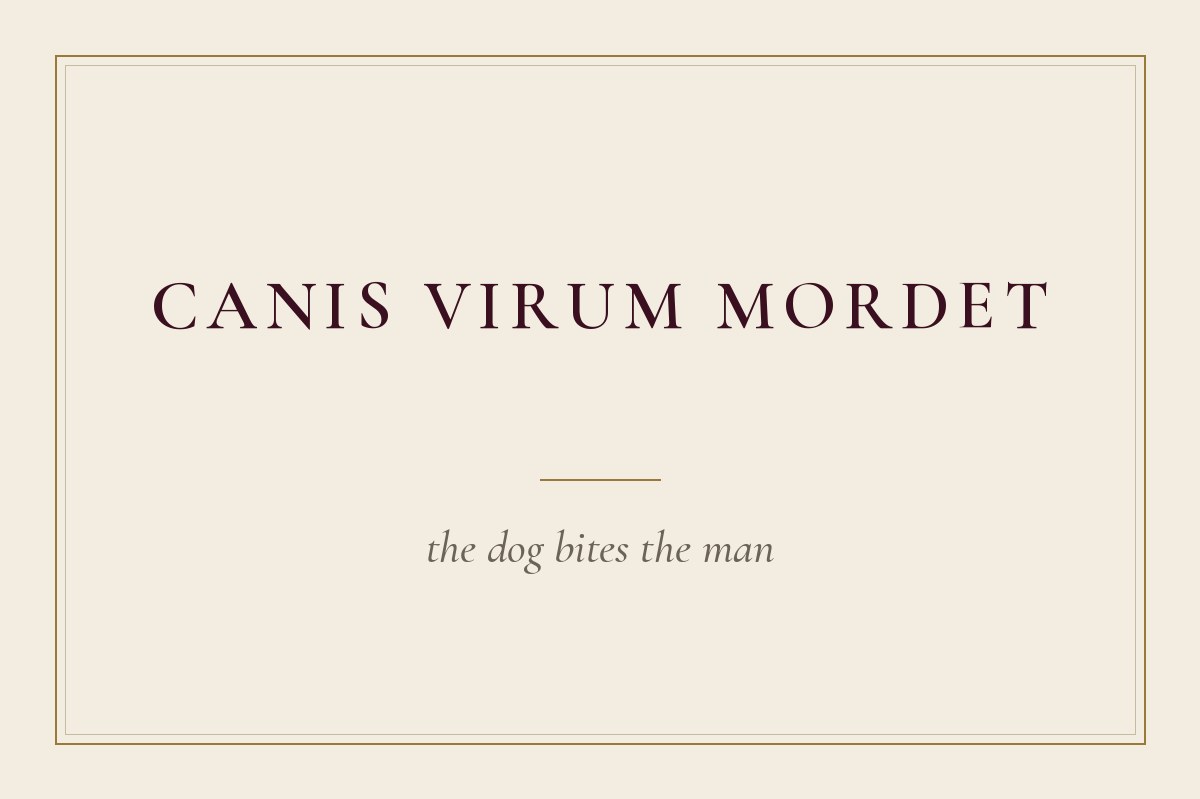
Canis virum mordet. Virum canis mordet.
Both sentences mean that the dog bites the man. A Roman would hear no difference in who did what, only in what the speaker wanted heard first.
No the, no a
Latin has no word for the and no word for a. Where English says “the dog” or “a dog,” Latin says canis and leaves the rest to the reader, who decides from context which English article fits. The French le and the Spanish el descend from the Latin ille, “that,” which came to do the work of an article only after Latin had given way to its daughter languages.
The ending does the work
English keeps its meaning in the order of its words. “The dog bites the man” and “The man bites the dog” use the same words and say opposite things. Latin keeps its meaning in the endings. The -um on virum marks the man as the one who is bitten, wherever he stands in the sentence.
What the freedom is for
Because the endings carry the grammar, a Roman could arrange the words for effect. The beginning and the end of a sentence are the places a listener remembers, and Latin writers put there the word they most wanted heard. Vergil opens the Aeneid with arma virumque cano: arms and the man I sing. Arma comes first because the poem is about war.
The first large change
A student who has read only English expects the first noun to be the doer and the second to be the receiver. Learning Latin means giving up that habit and reading for the endings instead. It is the first large change a student has to make. After it, a sentence is no longer a line to be read left to right but a set of relationships to be worked out. Read about our Latin courses.
Sources: Lewis & Short, s.v. ille; Vergil, Aeneid 1.1.
In Korean, with our administrator: book a phone call · chat on KakaoTalk
In English, with Ioannes Magister: book a Zoom call · message on WhatsApp
Or write to contact@emersonlatin.com.
Get word when something new is posted.
Join Our Mailing List