Latin and the Modern World
The Notebook John Locke Indexed
November 16, 2026
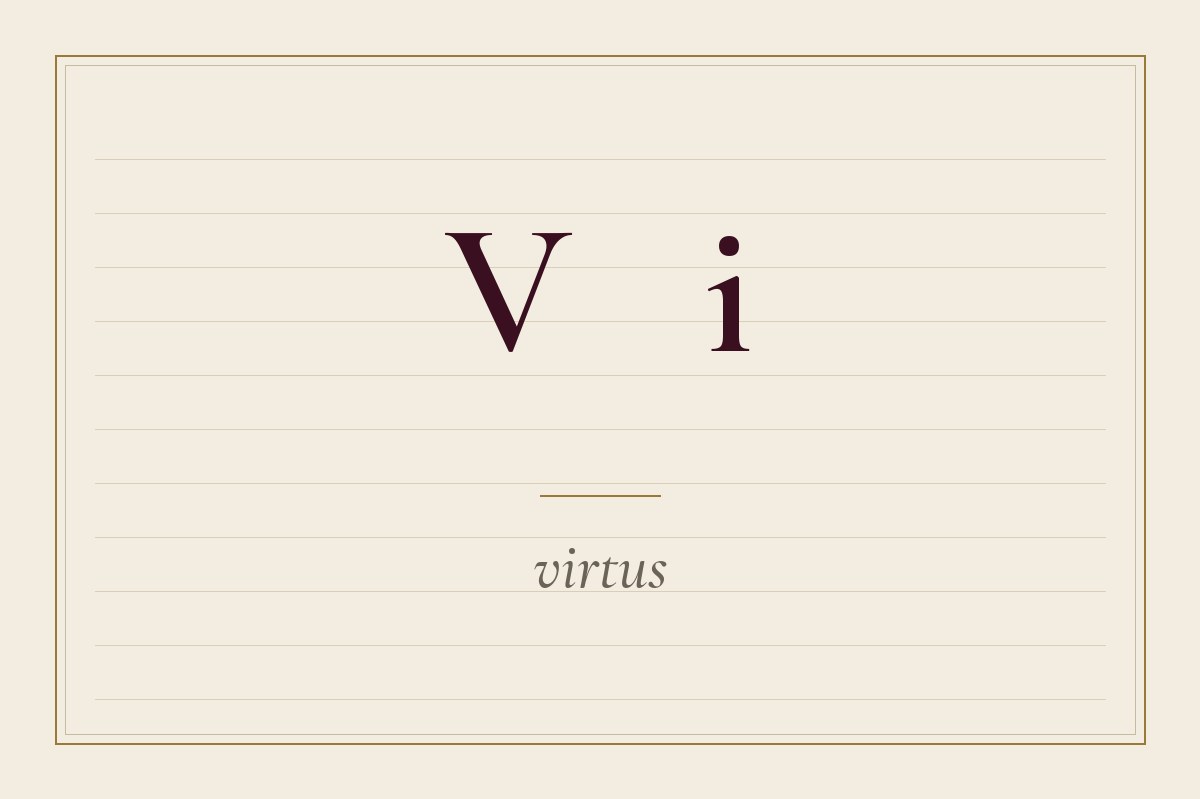
John Locke, the philosopher of liberty, filed the word virtus under V and i. It is a small, almost comic rule. It is also the difference between owning what you read and having once been near it.
A student’s notebook, 1652
Locke went up to Christ Church, Oxford, in 1652, and in that year he began the first of his commonplace books. A commonplace book is a notebook in which a reader copies out passages worth keeping and files them under headings. The name is Latin at the root: a locus communis, a common place, is a heading under which like passages are gathered. Locke kept such books for decades.
Two letters
A notebook filled in the order of one’s reading is easy to write and hopeless to search. Locke’s answer was an index built on a rule. Each entry is filed under a heading, and the heading is recorded in the index by its first letter and the first vowel that follows. He published the method in French in the 1680s. It appeared in English in 1706, two years after his death, as A New Method of Making Common-Place-Books.
An older habit
Locke did not invent the notebook. In 1512 Erasmus, in his De Copia, urged schoolboys to gather striking phrases and examples under headings, so that they would have something to say when the moment came. What Locke added was the index, which turned a heap of excerpts into a library a reader could walk through.
What a search box cannot do
We now hand children a machine that retrieves everything and asks nothing of them. A search box has no taste. It cannot tell a sentence worth keeping from a sentence that merely arrived. A commonplace book can, because a person decided. A person who must decide where a passage lives has first had to decide what it means.
Your child’s mind is not what she has read. It is what she has filed, and under what heading.
A little Hegel
Our Humane Letters Fellows keep a commonplace book, as Locke did, as an online notebook. We add a little Hegel to the way they gather and cultivate it. His word Aufhebung means to cancel and to preserve in a single act. An idea in the notebook is never left alone with its admirers. It is set against what opposes it, and what survives the meeting is what the Fellow keeps and grows. That is how a copied passage becomes, in time, an argument she can defend aloud.
From the notebook to the contest
Humane Letters Fellows write for the international writing competitions inside the course, and the notebook is where those essays begin. Ideas from seminar are captured while they are warm, then planted and given time to grow. Ideas of the kind that win international writing contests do not arrive from nowhere. There is a symmetry in it. One of the competitions in which our students have won commendations, the John Locke Institute’s Global Essay Prize, bears the name of the man with the notebook.
Open year round
Humane Letters is open year round, with rolling admissions. A student comes in by a short Viva, a conversation about a poem, and there is no season in which a notebook cannot be started. Read more about Humane Letters and our admissions.
If your child has ever copied a sentence out of a book for no reason at all, she has already begun. She only needs a heading.
In Korean, with our administrator: book a phone call · chat on KakaoTalk
In English, with Ioannes Magister: book a Zoom call · message on WhatsApp
Or write to contact@emersonlatin.com.
Get word when something new is posted.
Join Our Mailing List