Rant with a Philosopher · Ioannes Magister
The Word for School Is Leisure
Seneca says you are not busy. You are occupied, the way a city is occupied by an army.
November 21, 2026
What to expect: a rant is one angry idea, argued at full volume. Each week we take something from today or from ancient Rome, set one philosopher’s idea beside it, and see what burns. This week the philosopher is Seneca, and his idea is that we are not short of time. We waste it. The target is the overbooked child. Read it with your child’s calendar open.
The word
The Greek word behind “school,” skholē, meant spare time, leisure, rest, ease, even idleness. The basic sense was leisure. A school was a place where free people spent their free time. Now fill in an afternoon schedule and read the word again.
The haste
We call it ambition. It is flight. We hurry our children from one room to the next because the empty hour frightens us, and what would appear in it is a child alone with herself. The calendar is a sedative. We give it to her because we take it ourselves.
The slave
A person who does not own two-thirds of her day is a slave, whatever her title: student, executive, official, scholar. Count your child’s free hours. Then say the word out loud.
The Roman
Seneca wrote De Brevitate Vitae, “On the Shortness of Life,” around 49 AD, to a Roman official named Paulinus, a man with an important post and no time. Everyone complains that life is short, Seneca says, and he turns the complaint around: Non exiguum temporis habemus, sed multum perdidimus. We do not have a short time. We have thrown away a great deal of it.
He had a word for the people he scolded: the occupati, the preoccupied. The verb behind it, occupare, means to seize. A city is occupied by an army. A busy child is occupied the same way: seized, held, and not her own.
The grammar
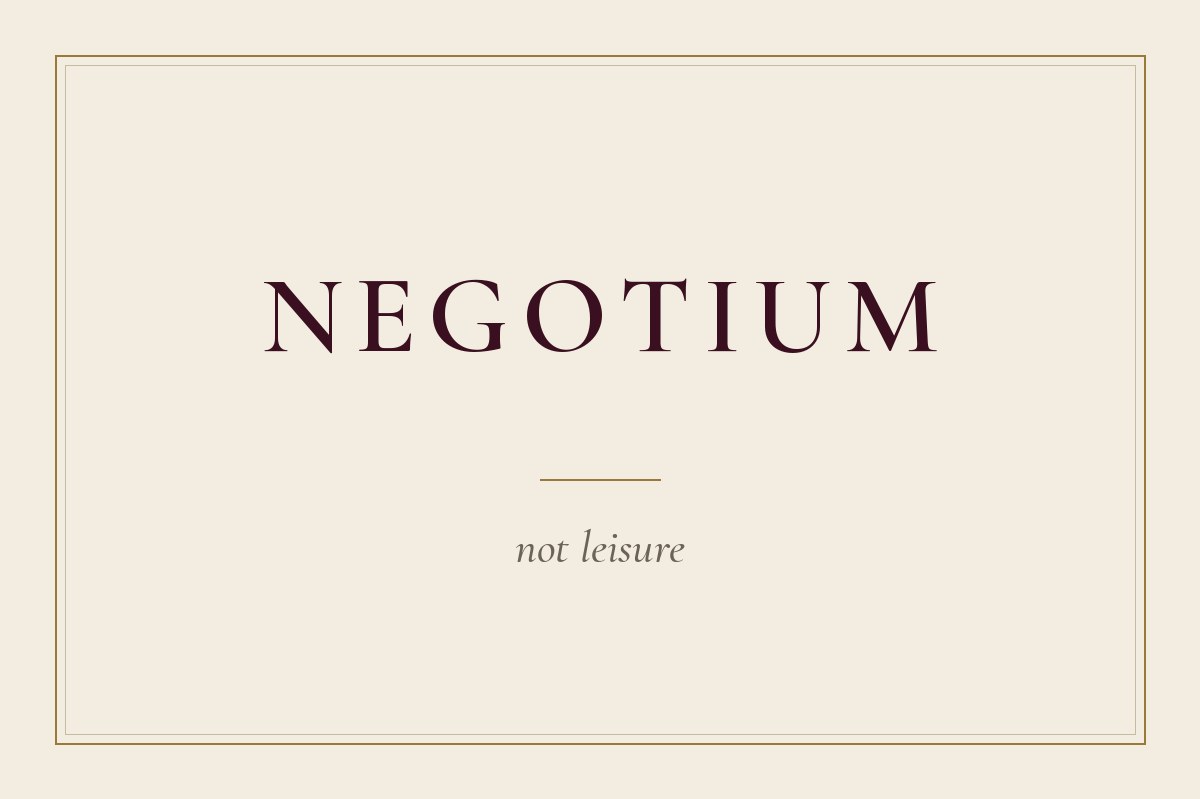
The Romans kept this in their language. Their word for business, negotium, comes from nec, “not,” plus otium, “leisure”: literally the absence of leisure. They did not define leisure as the gap between jobs. They defined work as the gap in leisure. We have reversed it, and the reversal is the sickness. “Rather do anything than nothing” is not a virtue. It is how a culture talks itself out of thinking.
The remedy
Give the child the afternoon, and give her something worth the afternoon. Seneca is one of the Roman authors we read, analyze and discuss in Latin Literature, Stage II, and Advanced Latin Literature, Stage IV, depending on the topics and themes of the year’s contests. Our students read him in Latin, slowly, with time to argue.
A school that leaves no free time has stopped being a school. It has become negotium, the very thing school was named to oppose. Give the child her day back. Then give her Seneca.
Sources: Seneca, De Brevitate Vitae 1.3; Etymonline, “school”; Harvard Center for Hellenic Studies, on negotium; Daily Stoic, on the date and addressee.
In Korean, with our administrator: book a phone call · chat on KakaoTalk
In English, with Ioannes Magister: book a Zoom call · message on WhatsApp
Or write to contact@emersonlatin.com.
Get word when something new is posted.
Join Our Mailing List